
Turtle E.R.: A special hospital for North Carolina's sea turtles
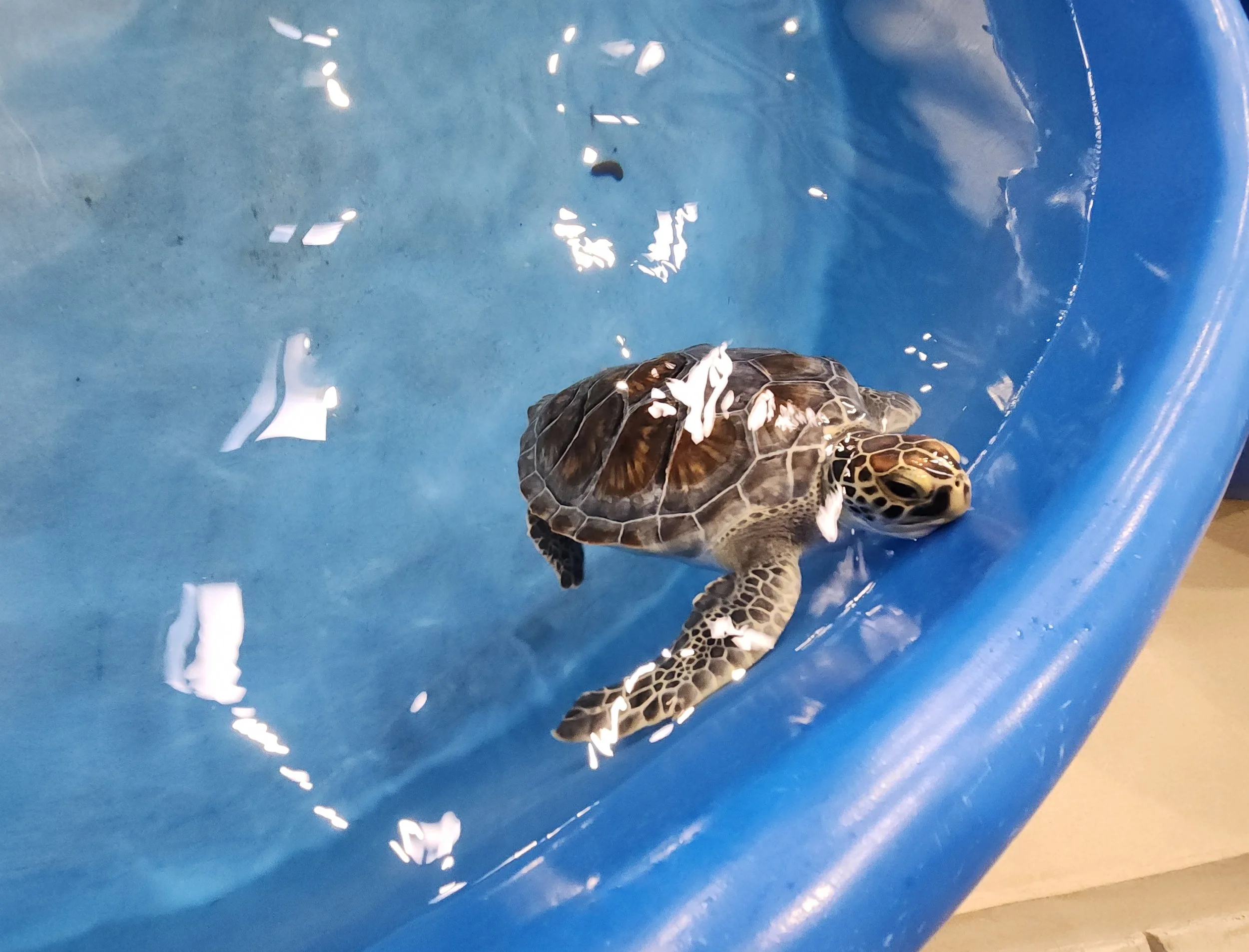
Pumpkin Spice has been through a lot, the scars on his back telling his difficult story. According to Kathy Zagzebski, he’s a survivor. Pumpkin Spice is a juvenile Loggerhead sea turtle that made it to a special North Carolina hospital where he was recovering from a boat strike in a large round tub.
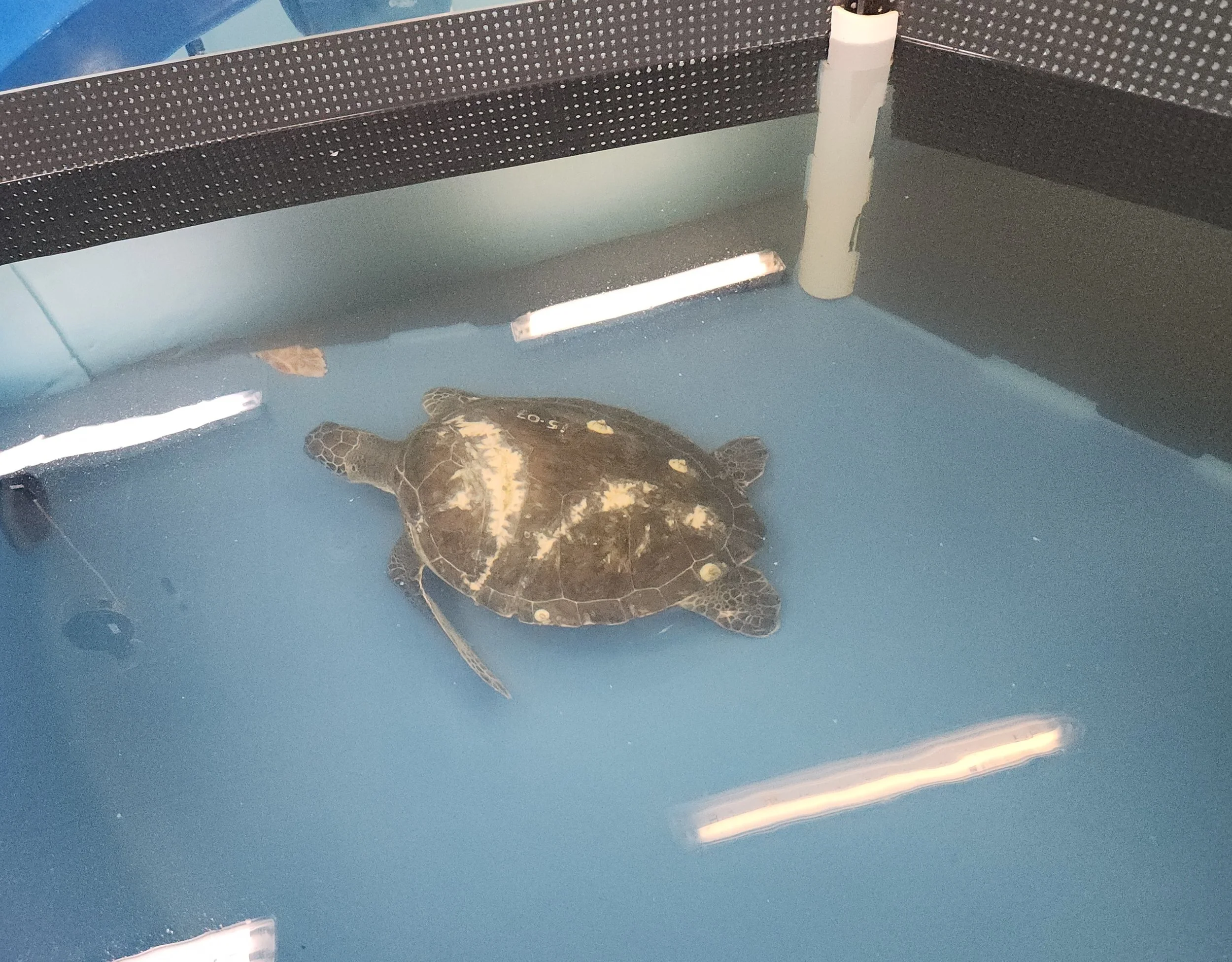
Pumpkin Spice is a Loggerhead turtle who ended up in the hospital after a boat strike. Photo by Carrie Dow.
Zagzebski says that even though the boat struck his spine, he wasn’t paralyzed because he could move three of his flippers and defecate. His prognosis was good. However, she noted there was more to Pumpkin Spice’s story visible in the scars on his mottled shell.
“This turtle was bitten by a shark,” she said, pointing to two sets of half circle marks. “You can see the two bite marks, one there and another up there. Somehow, he got away, not once but twice.”
Zagzebski is the Executive Director of the Karen Beasley Sea Turtle Rescue and Rehabilitation Center in Surf City, North Carolina, located northeast of Wilmington. They provide medical care for sick and injured sea turtles from beaches along the East Coast and release them back into the ocean after they have recovered. Almost 30 years old, it’s one of the oldest facilities of its kind and well known in the marine animal rescue community. However, the organization had humble beginnings as a mother-daughter passion project.
***
Back in the 1970s, North Carolina native and Duke University grad Jean Beasley and her family had a beach house on Topsail Island where they would vacation every summer before moving to the island permanently in the early 80s. One early spring morning while walking on the beach, Jean, a teacher and school administrator, and her teenage daughter Karen came across a sea turtle laying eggs. After the turtle returned to the water, Karen worried about predators or people stumbling into the nest, so she and Jean called local authorities to ask what they should do. They were told that turtles don’t nest on Topsail Beach so there was nothing official for anyone to do. Karen, with her mother’s help, decided to protect the nest and look for others on the island and they decided to do it every year. And every year they found more and more nests. Contrary to what they had been told, sea turtles were nesting on Topsail Beach.
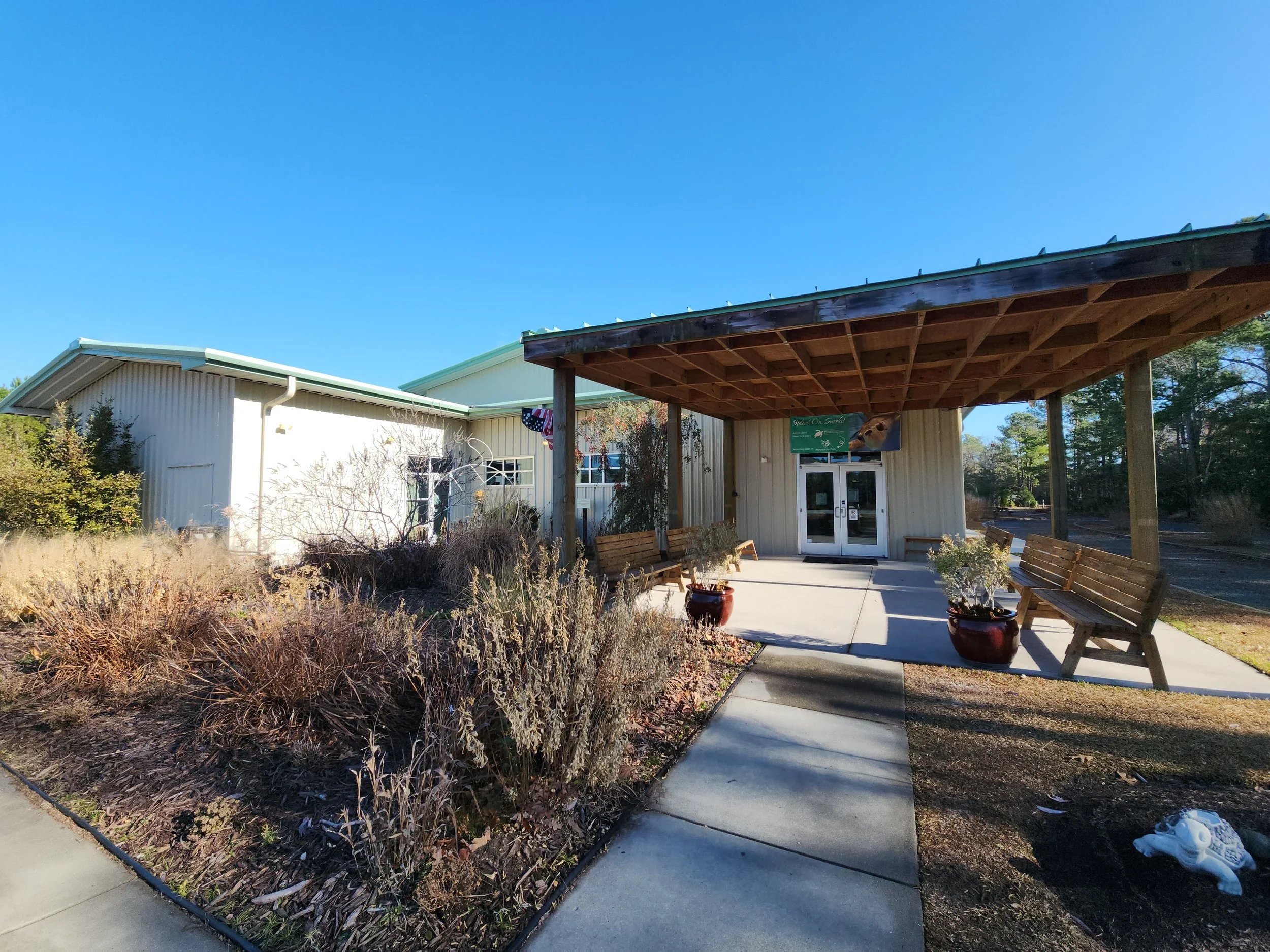
Entrance to the Karen Beasley Sea Turtle Rescue and Rehab Center. Photo by Carrie Dow.
It was a DIY operation as the duo educated themselves on how to protect and ensure the tiny hatchlings made it out every summer. As the number of nests grew, they began recruiting friends and neighbors to help. They had no problem finding eager volunteers because who doesn’t love turtles? And as more people volunteered, the more beach they could cover.
By the 1980s, Karen had founded the Topsail Turtle Project, a nonprofit organization that today oversees 26 miles of coastline during turtle nesting season from May 1st through August 31st with roughly 100 sea turtle nests a year.
However, Jean and Karen’s turtle story wasn’t done.
Karen, a Wake Forest University grad, passed away from leukemia in 1991 at the age of 29. Before she died, she asked her mom to use her life insurance policy money to continue helping sea turtles. That was when Karen’s mission became her mom’s.
Things changed again in 1996 when volunteers found a turtle in bad shape. Jean took the turtle – which volunteers nicknamed Lucky – to North Carolina State University’s Veterinary Center, where they came up with a plan to nurse Lucky back to health. Jean was surprised, however, when the school told her she would be taking Lucky home with her instead of staying at the school. She later told a local newspaper that she kept Lucky in a bathtub until it was well enough to go back into the water. Lucky’s release gave Jean a new sea turtle mission.
That mission became the rescue and rehab center named after her daughter which opened its doors in 1997. The first facility was only 900 square feet, and the concept of turtle rescue was still new. Many of the techniques Jean and her volunteers used to care for turtles were developed from practice and constant monitoring to learn what sea turtles needed to survive. Soon Jean was collaborating with state and regional universities on sea turtle medical and behavioral research projects. Over the next two decades Jean was named as an author on over 30 academic papers published in journals such the American Veterinary Medical Association and the Journal of Wildlife Management becoming internationally known in the turtle conservation community before her retirement in 2019 at the age of 84.
In 2013, the center moved into a 13,000 square foot facility that provides advanced medical care for as many as 110 turtles and up until 2020, the organization was completely volunteer. Today they have seven paid staff members and 575 volunteers between the Topsail Project and the hospital. A nonprofit organization, they rely on combination of public donations, corporate sponsorships, and grants, but they also have a large gift shop (“everything turtle you could ever want,” laughed Zagzebski), and they host incredibly popular public tours throughout the year.
***
Zagzebski gave me a tour during the hospital’s busiest time of year, the holidays. That’s because winter is a perilous time for sea turtles. That’s why the center is closed to the public during winter months because it’s all hands-on deck in the hospital. They had 82 turtles during my visit.
In winter sea turtles can develop a condition called Cold Stun Syndrome. Cold stun is basically severe turtle hypothermia, and it happens when water temps drop below 55 degrees. The cold stops the turtle from functioning. They stop eating and to preserve vital organs, blood stops flowing to extremities. They can also develop pneumonia.
Atlantic sea turtles normally swim to the warm waters of the Caribbean in winter, but there are a variety of reasons why they don’t get there. The biggest reason is climate change. Warmer fall weather and hotter sea temperatures can fool turtles causing them to miss the cues to head south. Sometimes turtles end up in inlets or estuaries and can’t find their way back to the ocean.
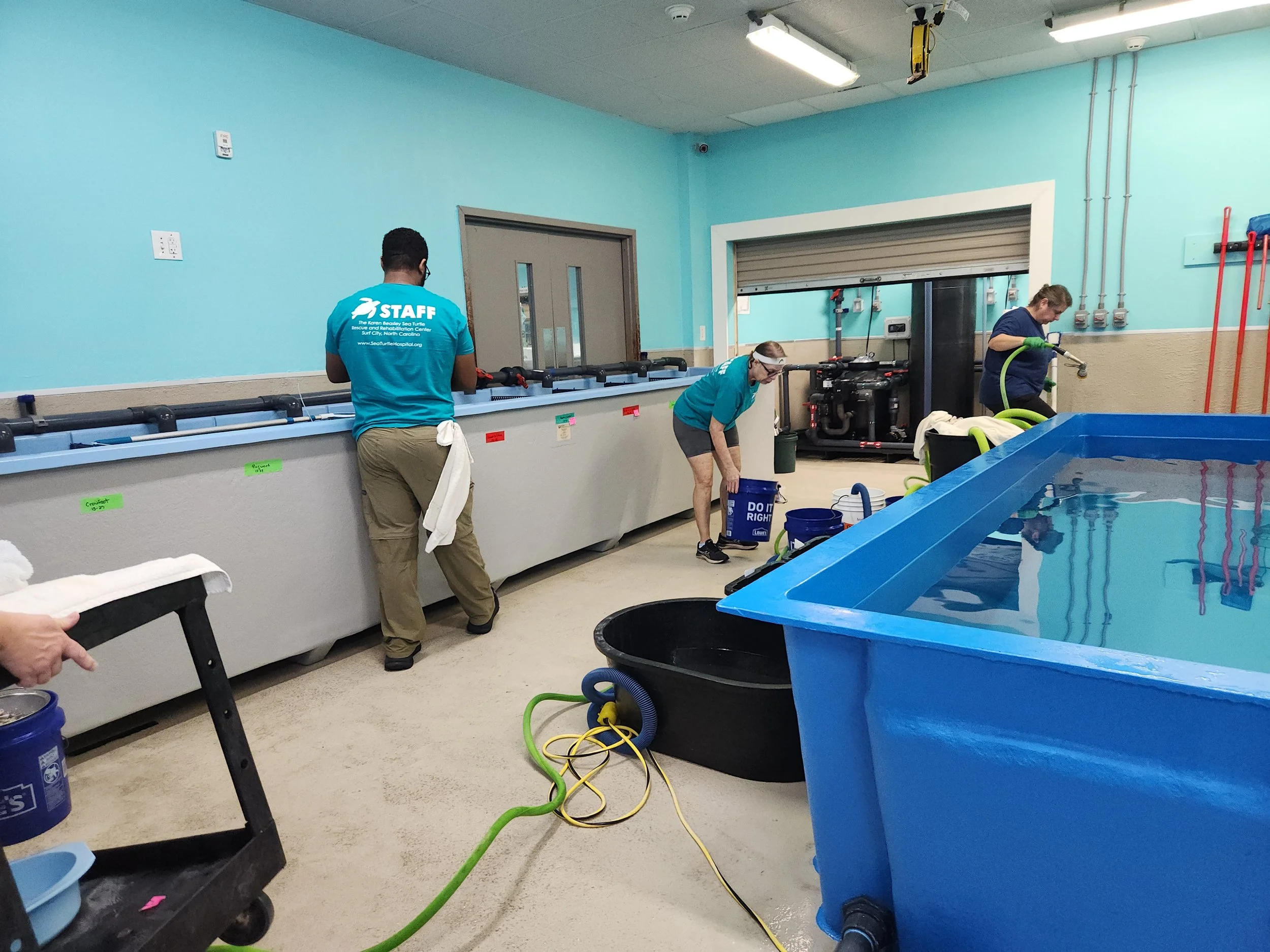
Staff and volunteers working in sick bay. Photo by Carrie Dow.
“They’ll float around for a while until the wind or waves wash them a shore,” she said, which is where people find them. “By the time they strand, they are severely debilitated.”
To save a turtle from cold stun, they must be warmed gradually over a few days. They are also given fluids for hydration and food, and kept in small tanks, usually small plastic tubs, so they can rest and not have to swim. Once the turtles’ body temperature returns to normal, they can be moved into bigger tanks where they can swim a little bit and receive regular food, like lettuce and fish, depending on their age. All turtles are weighed daily, and their measurements taken weekly. Zagzebski says their ability to eat food is an important health indicator. Turtles who are eager to eat and want more is a good sign. Turtles that aren’t eating and/or losing weight take longer to heal. Treatment can last a few weeks to several months and they keep the turtles as long as necessary only releasing when ready.
Cold stuns happen up and down the East Coast. In Cape Cod, Massachusetts, where Zagzebski worked at a marine rescue center before coming to North Carolina, turtles often get caught in the state’s “arm” in the winter. In North Carolina cold stun turtles are typically found in Cape Hatteras and Cape Lookout. Of the 82 turtles in the hospital, 27 are from Cape Cod. The center often takes in turtles from other areas if they have room.
“We all work together even though we are different organizations. It takes a village!” she noted.
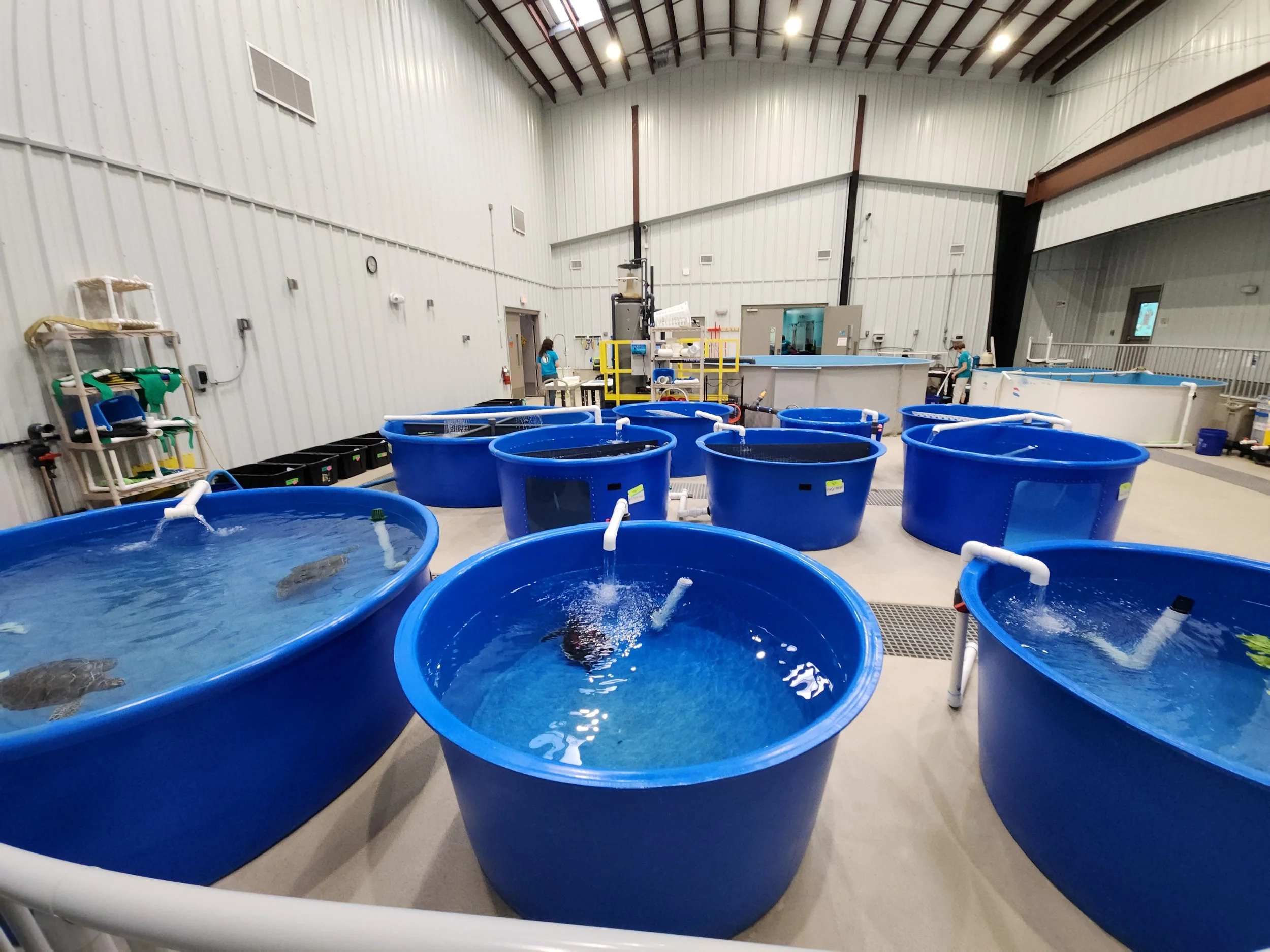
The hospital’s turtle bay rehabilitation area. Photo by Carrie Dow.
While the hospital is currently busy with cold stun season, sick and injured turtles show up all year long. However, the two main reasons turtles end up in the hospital are because of human activity – boat strikes and swallowing fishhooks and trash.
***
What makes turtles, members of the reptile family, unique is their shell, called a carapace. The inner layer of the carapace is bone – the ribs are attached to the carapace – and the top layer is keratin, the same substance as our fingernails and hair. Their spine runs along the middle of the carapace so when a boat’s propeller strikes the shell, if it crosses the spine, the turtle can end up paralyzed.
There are seven species of sea turtles worldwide and all are on some level of endangered. North Carolina sees mainly three species – Loggerhead, Green, and Kemp’s Ridley. On rare occasions, Leatherback and Hawkbill turtles from the tropics have been spotted. Kemp’s Ridley turtles are a small, rare sea turtle species normally found in the tropics, however, Zagzebski says they are showing up more often in North Carolina with one nest here last summer.
As the world’s most common sea turtle, Green turtles make up about 57 percent of the hospital’s patients every year. They are also the species that has had the greatest recovery from the endangered species list and Zagzebski says the population in the Western North Atlantic is particularly robust. Green turtles get their name not from the color of their shells, which varies from olive to brown to black, but from much deeper. Zagzebski says that as juveniles, they are omnivores, but as adults are fully vegetarian, eating only sea grass.
“That’s why they’re called Greens,” says Zagzebski. “They’re not green on the outside; They’re green on the inside. All that grazing turns their fat green.”
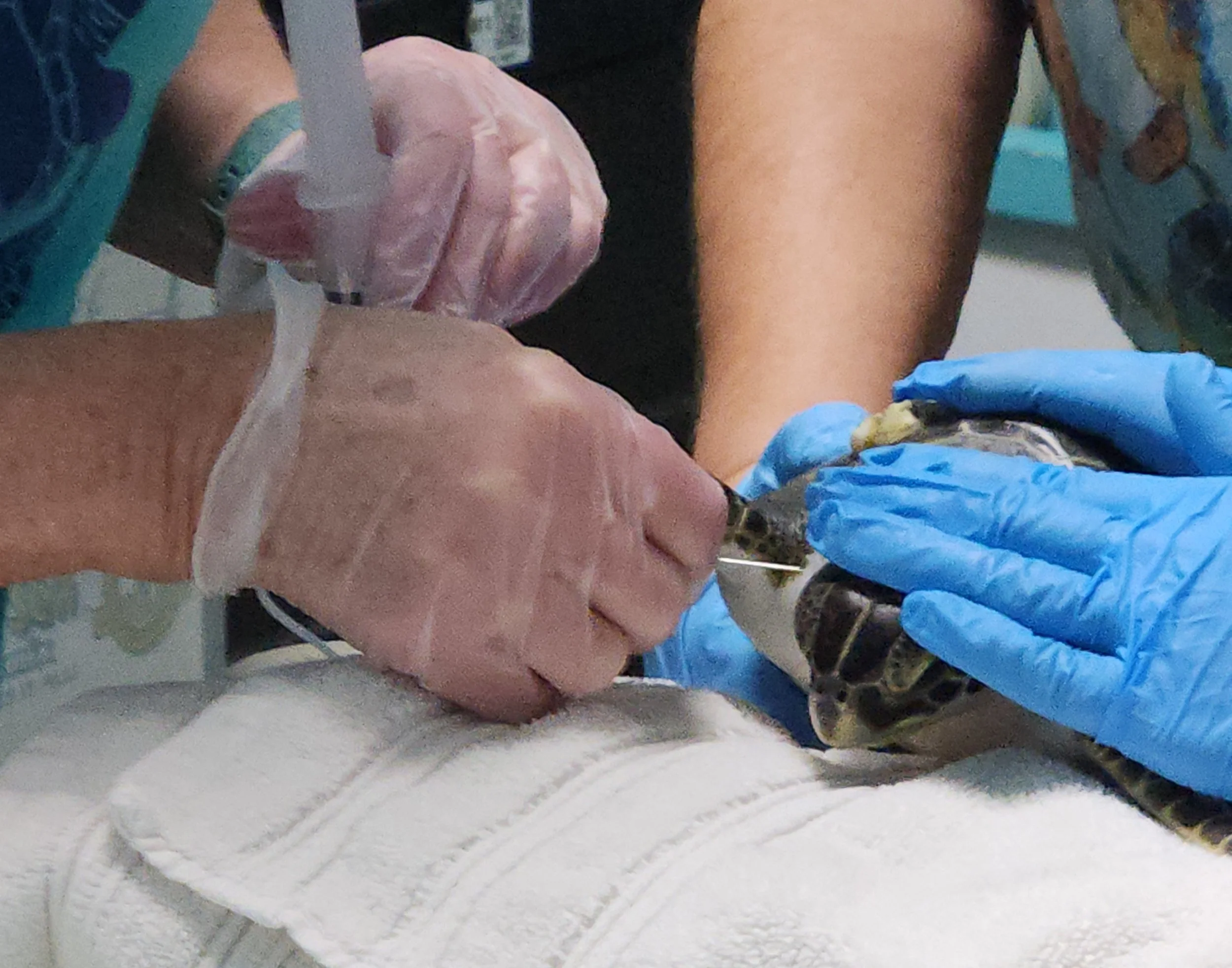
A turtle getting IV fluids at the Karen Beasley Sea Turtle Hospital. Photo by Carrie Dow.
The hospital has two areas where turtles are nursed back to health. Sick bay, where Pumpkin Spice recovered, is where the newest and most serious cases are cared for. Along the room’s walls are long tanks called raceways that staff can put dividers in at intervals creating separate tank spaces depending on how many or how big the turtles are.
Next to sick bay is a bigger area called turtle bay, which has larger tanks so turtles on the mend can swim around and prepare to go back into the ocean. Both areas are maintained with a recently upgraded and expanded filtration system that grant funding help pay for. The upgraded system allows them to filter the water in more tanks and larger tanks. Better filtration means they don’t have to physically handle the turtles as often, which is better for their survival, and it makes things easier for the humans because people don’t have to lift the turtles, dump the water, replace the water, and then move the turtles back, although Zagzebski says they still use the small tubs for the cold stuns, which are called ‘dump and fills’ because volunteers need to dump and refill the water three times a day.
Also in turtle bay is a large therapy pool that can hold one large turtle or several small turtles at once. The therapy tank is sunk into the floor so it’s even bigger than it looks. Zagzebski says they rotate turtles in the therapy tank where they have more room to swim around. Turtle bay’s large round tanks also have dividers that section them into pie slices to hold one to four turtles.
Once in turtle bay, they can eat regular food, which the hospital buys from a bait shop in Morehead City that not only provides bait to commercial fishing boats, but to North Carolina aquariums. Zagzebski says they feed three different species of fish along with squid and shrimp. If a turtle isn’t eating, they will try crab as an enticement, however, it’s too expensive to use regularly. She says they spend just under $30,000 a year on food, but that’s not their biggest expense.
“Even though we’re near the ocean,” says Zagzebski, “we have to make our own salt water.” They go through about 20 boxes of marine salt a day, boxes that weigh 43 pounds each. Zagzebski says they spend about $100,000 annually just on salt.
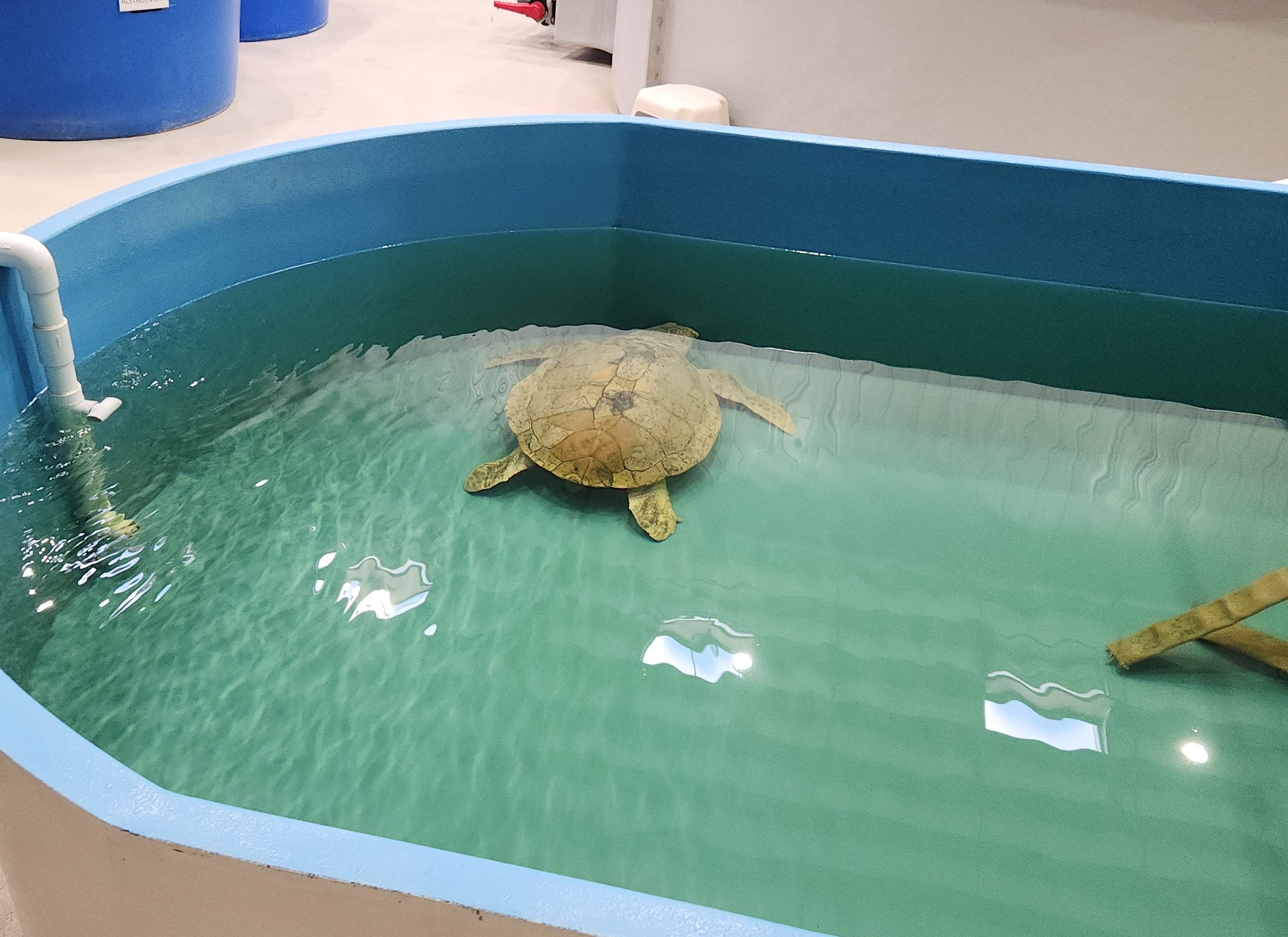
Lennie is a permanent resident at the Karen Beasley Sea Turtle Hospital. Photo by Carrie Dow.
Also in turtle bay are the hospital’s permanent residents, Lennie, Lichen, and Pansy. Lennie, who they’ve had since 2006, is an adult female Kemp’s Ridley turtle that the hospital kept because she is totally blind due to blunt force trauma to her head. She was rescued as a juvenile, so Zagzebski believes she is in her mid-20s. However, keeping turtles permanently isn’t something the hospital was designed for, nor can they do it very often. That is because, as a wild animal, sea turtles must be authorized by the U.S. Fish & Wildlife Service.
“We can’t just keep turtles if we want to. We have to go through a special permitting process,” Zagzebski explains. “We also have to do reports every year.” Although permanent residency for Lennie has its perks. Staff and volunteers interact with her often providing enrichment toys, special treats, and, adds Zagzebski, she likes to have her carapace rubbed with a soft-bristled hairbrush.
***
Zagzebski says turtle release days are special occasions. Announcements are made so the public can watch, from a safe distance of course. Large turtles are wheeled to the beach on a cart as onlookers take photos. In winter, turtles are released at sea into the Gulf Stream’s warm waters from fishing boats, research vessels, or by the Coast Guard. This method is preferred because it’s easier for the turtles, but it’s sad for staff because they can’t go along and say goodbye. They have already released 11 of the 27 Cape Cod cold stuns and have others ready for release, but have to wait for the weather and the boat captains’ schedules to cooperate. While they put tags on all the turtles they release, they don’t do any satellite tracking.
While the hospital offers seasonal public tours, Zagzebski says, people are not allowed in sick bay. They can only observe from windows.
“Our first job is as a hospital to help the turtles. People don’t get to feed the turtles, touch the turtles, or swim with the turtles,” says Zagzebski. And she would like for men to stop calling the center to see if a turtle can carry their girlfriend’s engagement ring to her. It’s not allowed.
***
After her retirement, Jean Bealsey moved out of state to be closer to family, but returned to the turtles every summer. In 2022, she received the Thomas L. Quay Wildlife Diversity Award from the NC Wildlife Resources Commission in recognition of her lifetime commitment and leadership in wildlife conservation. She passed away on December 2, 2025, at the age of 90.
She and her daughter will be remembered with every turtle saved.
***
What to know:
Tickets for the public tour must be purchased online in advance. Visit the website to see tour dates and times and purchase tickets.
For area residents who want to work with turtles, there is a long waitlist for hospital and beach volunteers. However, volunteers are needed in the gift shop and as tour guides. Zagzebski recommends people start in these volunteer positions first and then transition to the hospital side as those become available. For college veterinary students, the hospital has internship programs, and some programs include housing, stipends, and class credit. Learn more on the website.
If you come across a sea turtle that’s sick, injured, or dead in North Carolina, call the North Carolina Sea Turtle Stranding Hotline:
252-241-7367
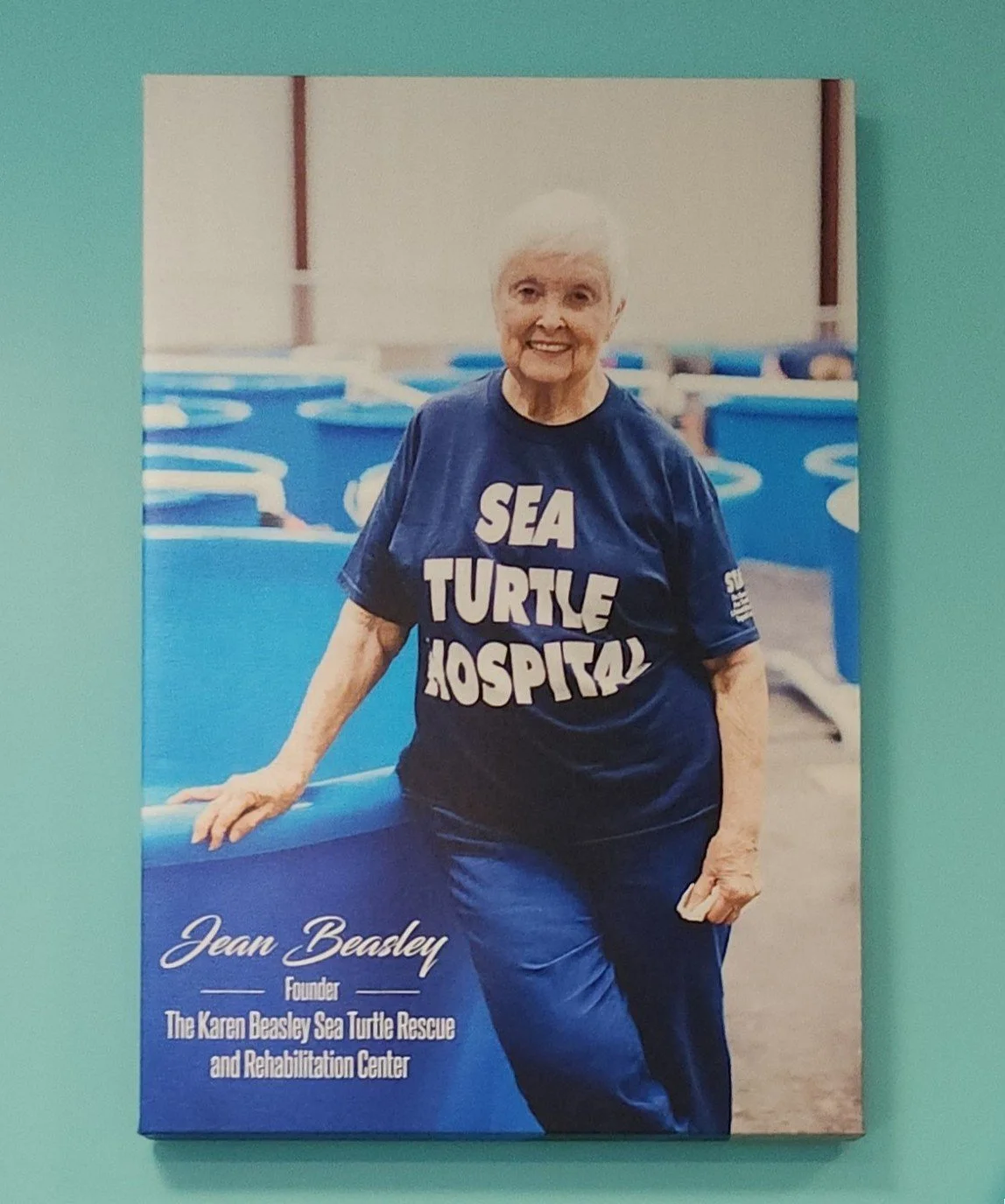
Sea Turtle Hospital founder Jean Beasley. Photo by Carrie Dow.


