
Viewing Alaska's Unique Animals by Land and Sea
Alaska is home to amazing animals and beautiful landscapes. Here are two ways to see them without a long hike or a large expense.
My husband said he had a short list of critters he wanted to see on our Southern Alaska trip last summer – bear, moose, and salmon. We saw those animals, and many more, on two different animal experiences, one on land and one on the water. Depending on your time and itinerary, you can do the same.
Not-so-wild wild animals: Alaska Wildlife Conservation Center
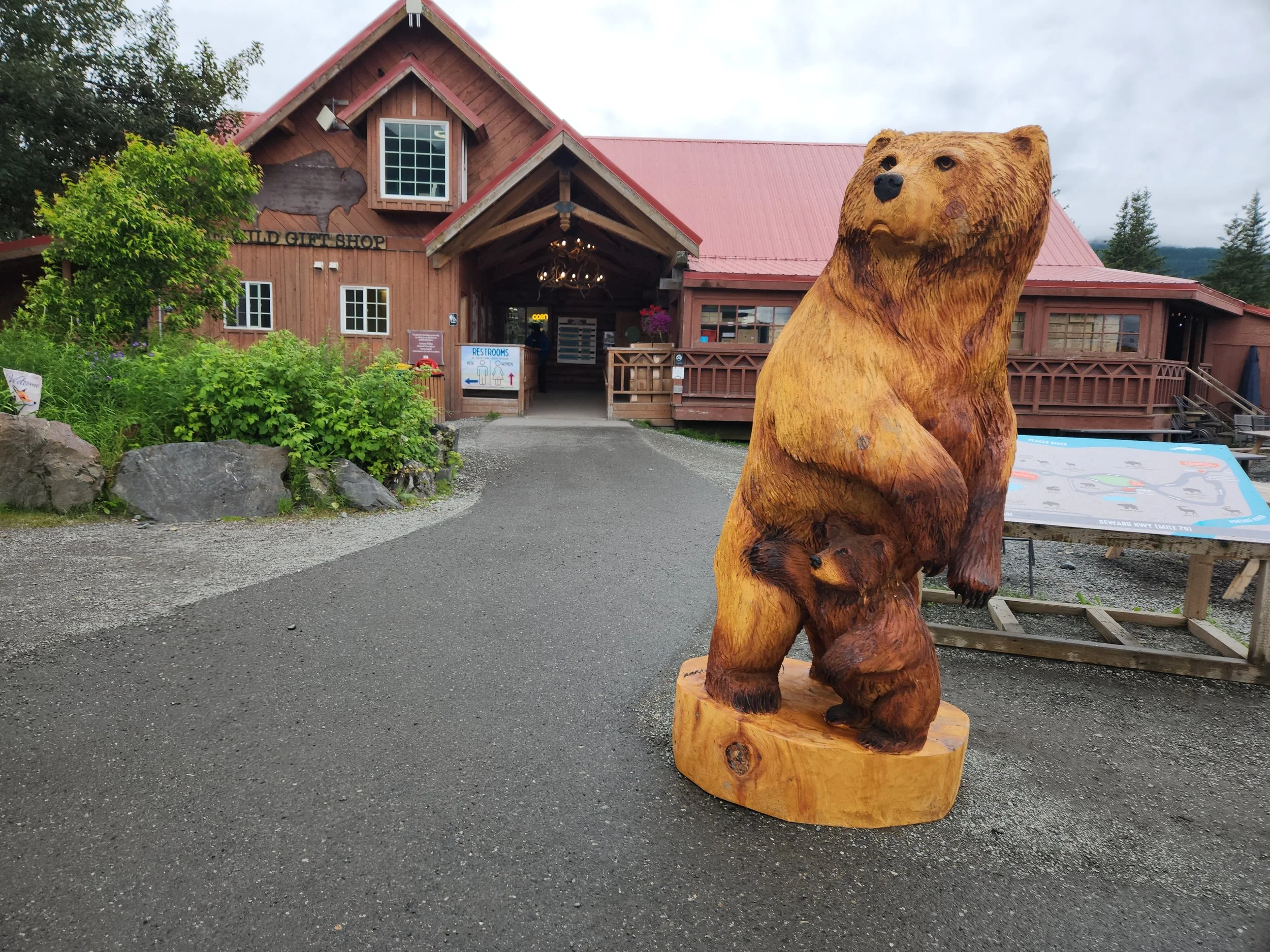
Visitor’s center at AWCC. Photo by Carrie Dow.
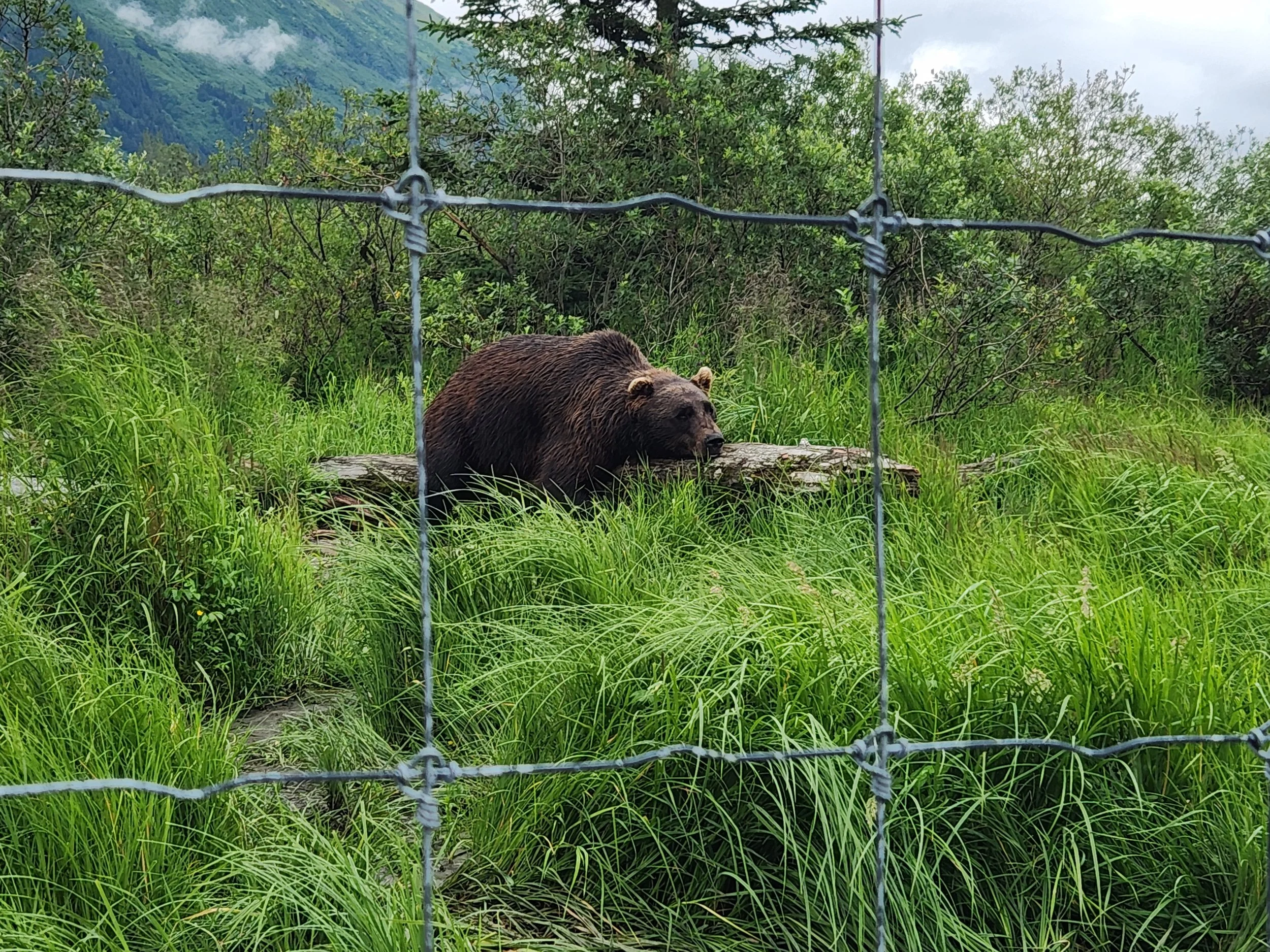
Joe Boxer, or JB, was completely stretched out on his belly on a fallen tree truck only 20 feet from the fenced barrier that separated this giant brown bear from my tour group. His limbs fell down each side of the trunk, and his chin rested on the grey weathered wood, his eyes closed. He was completely unbothered by the group of people taking his photo and oohing and aahing at how adorable he looked from behind the safety of the fence. His sister Patron was nearby rolling around in grass so tall I can only see the top of her furry back. Both bears were orphaned as cubs in 2004.
A third bear, a female grizzly named Hugo, was found orphaned near the Arctic Circle in 2000 and shared the enclosure with JB and Patron, however, she’s much smaller. Our tour guide Kristina explained that as you go further north, the bears get smaller in size because food takes more work to find.
Bears were just one of the many different species you can see at the Alaska Wildlife Conservation Center (AWCC) near the ski resort town of Girdwood in southern Alaska. Founded in 1993, the organization began with a small herd of plains bison and today has grown into over 200 acres with over 25 rescued animals large and small along with small herds of elk, wood bison, caribou, and musk ox. It’s one of Alaska’s most popular tourist attractions.
It was a chilly, rainy day on our visit in mid-July, however, the animals didn’t mind at all. While us humans were bundled up in coats, hats, and gloves, a blustery wind didn’t stop the animals from roaming their enclosures or lounging outside in full view. Some of the site’s smaller animals, a ferret-like marten named Marvin and two coyotes, were walking around their enclosures, just as curious about the group of humans who had gathered around to see them.
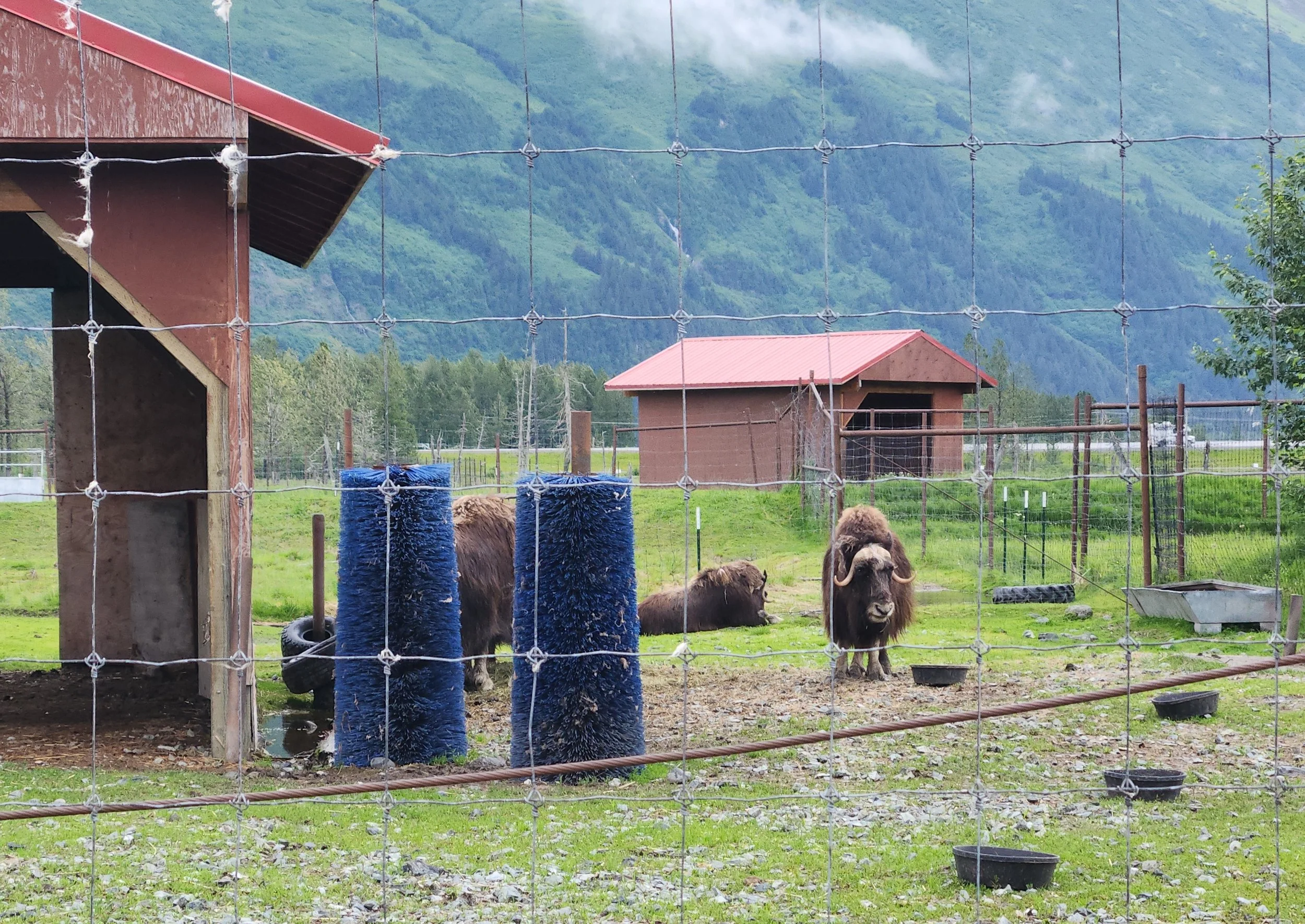
Muskox enclosure at AWCC. Photo by Carrie Dow.
Kristina, AWCC’s Naturalist Supervisor, gave our group a tour, leading us to different enclosures and telling us about each animal, not only about its species, but how the animal ended up in the AWCC’s care and any unique characteristics the animal had. One animal was Snappy the owl, who stares at us with bright yellow eyes. Snappy was currently the only bird in the AWCC’s care, but they’ve had others, including a beloved bald eagle that lived at the center for over 30 years. Kristina said that if human eyes had the same eye-to-eye-socket ratio as owls, our eyeballs would be the size of grapefruits.
Kristina then introduced us to her favorite animals, the muskox. She liked them because they are the only animals unique to Arctic and because they had curved horns that reminded her of handlebar mustaches. However, the animals were almost hunted to extinction in the 1800s. In the 1930s the Alaskan government brought over a herd from Greenland and successfully reintroduced them back into Alaska with most living on the northwestern edge of the state. Kristina says some 4,000 muskox free range in Alaska. They have 14 currently in their care, most coming from a muskox facility in Fairbanks while others arrived after being orphaned. She added that they can be goofy and have big attitudes, making them fun animals to be around.
As she spoke, one muskox munched on hay while three others lounged on the ground nearby. A child in our group asked about the giant blue structures in the enclosure. Kristina laughed and said they were the metal rolling brushes from street sweeping equipment. Apparently, muskox like to brush up against the bristles for scratches.
Other animals we visited were moose and Sitka black-tailed deer, which Kristina said were the second smallest deer in North America. Only Key deer in Florida were smaller. I found it amusing that the two smallest deer in North American exist on opposite end of the continent.
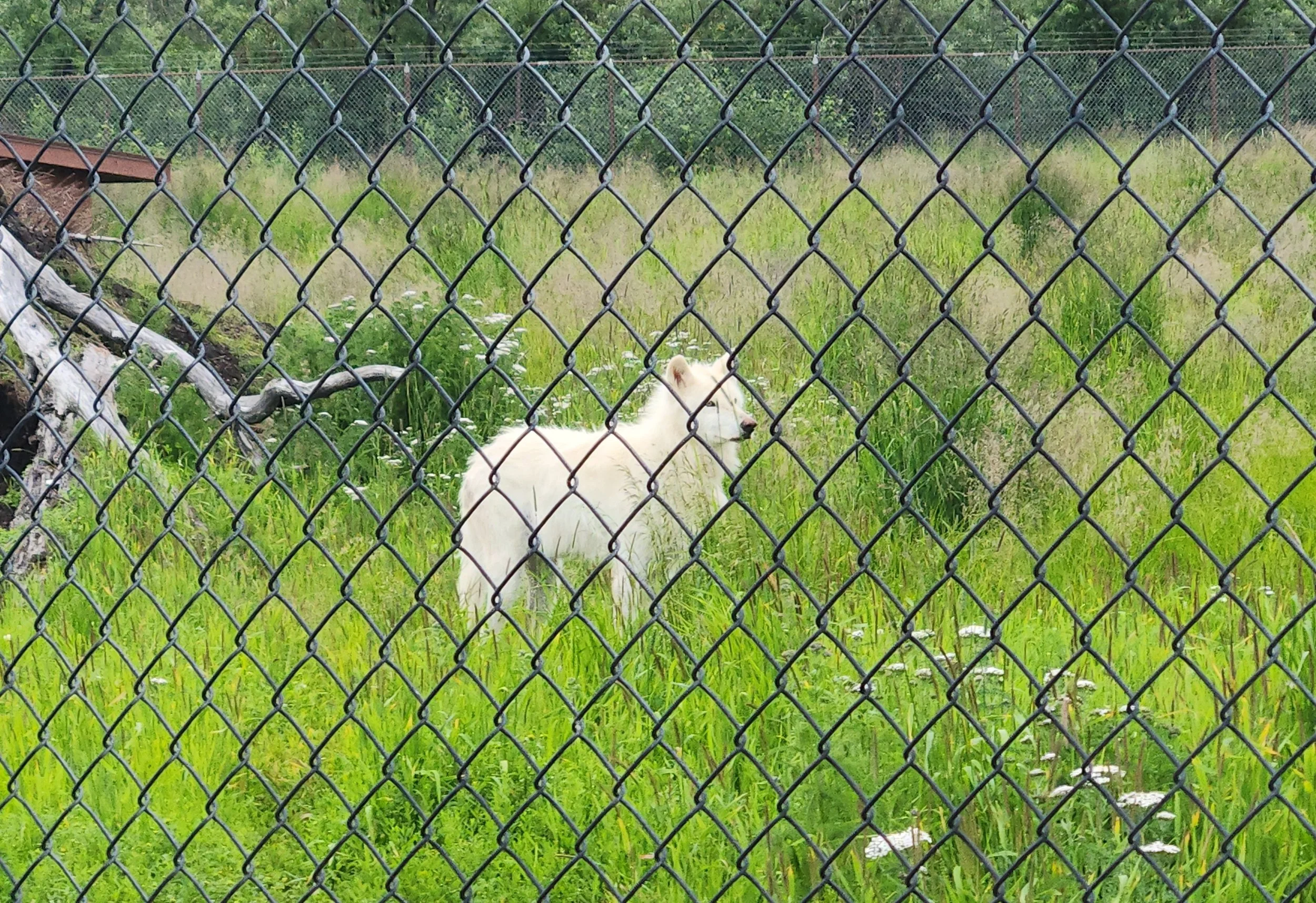
Dirus the grey wolf at AWCC. Photo by Carrie Dow.
Along with the muskox, AWCC also cared for a small herd of wood bison, the largest of North America’s native land animals and hunted to extinction in Alaska. Several decades years ago, a small plane flying above a national park in northwestern Canada spotted a robust heard. In 2008, 53 bison from Canada were transferred to AWCC to reestablish the herd in Alaska. Working with the Alaska Department of Fish & Game, they have reestablished a small herd, but still care for a few breeding pairs on site. Because the goal is for these animals to go back into the wild, most of the wood bison are off limits to the viewing public so the tour didn’t include them.
The last animal enclosure we visit is for Dirus a 10-year-old grey wolf. His coat was bright white because these wolves typically live in snowy regions. Kristina says there were once five wolves sharing this enclosure, but the other four all passed away from old age, leaving Dirus by himself, which made me sad. However, Kristina says AWCC is actively looking for other wolves so he can be part of a pack again. Watching him look off into the distance as the wind blows the fur around his face reminds me of my own dog.
Animals in the wild: Kenai Fjords National Park Cruise Tours
It was warm sunny July morning as we stood on the upper deck of the Calypso Voyager catamaran. However, we were still bundled up in layers of long sleeves, jeans, and wool socks because the temperature in Seward was expected to be in the 60s. Once on the waters of the northern Pacific Ocean, it would get colder.
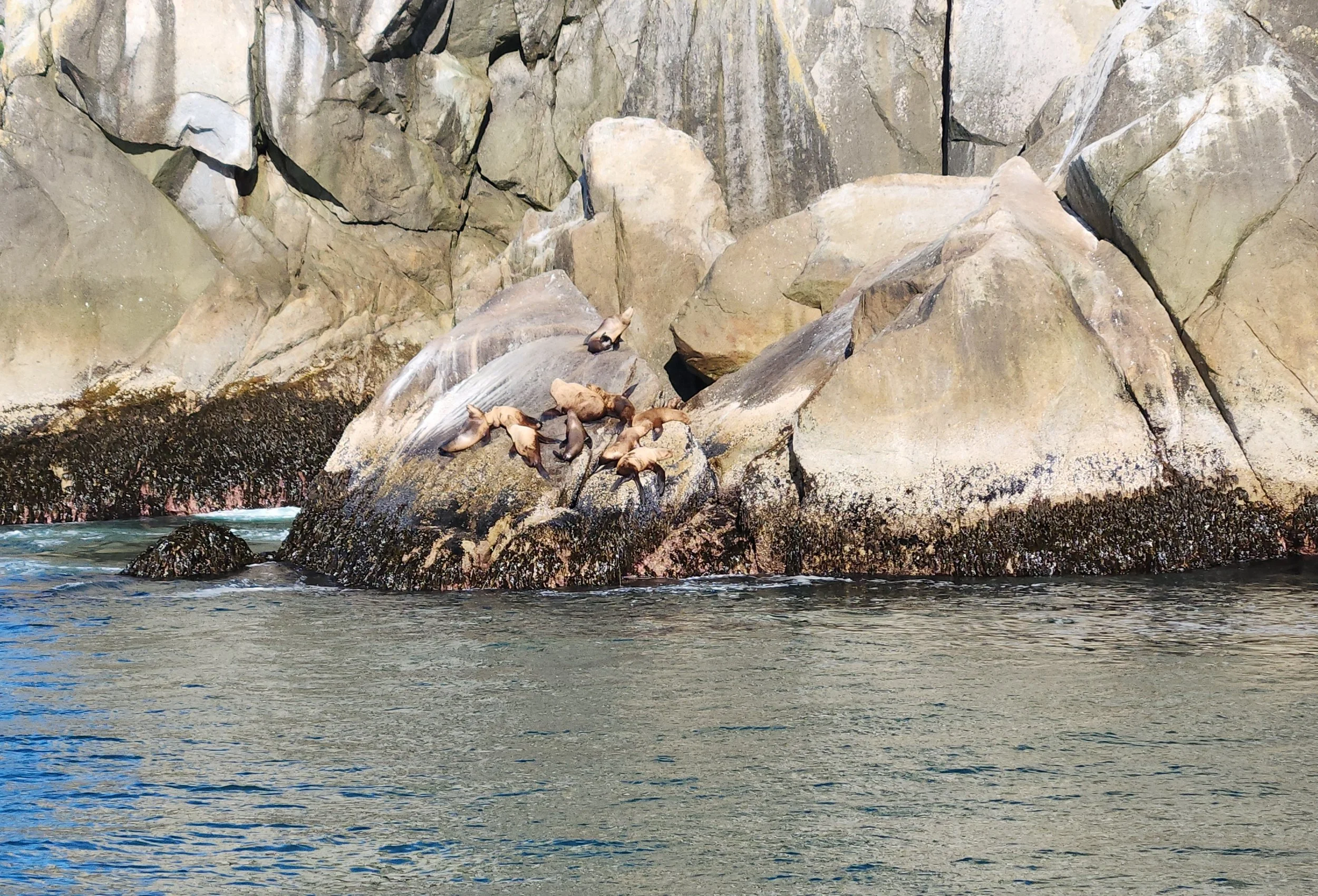
Sea lions on the Kenai Fjords National Park Cruise. Photo by Carrie Dow.
The blue and white boat was completely full as we pulled out of the dock and because we arrived a bit late, there were no seats left on the outside deck. That was fine with us because we had a front-row spot on the rail to see all the animals that we were expected to see on this six-hour tour. The catamaran had lots of amenities, like three clean restrooms, called heads, and a snack bar with refreshments and merchandise for sale. The bottom was fully enclosure with a walkway around the outside. The upper deck had smaller inside space with mostly outside seating on the back. We stood along a short walkway alongside the interior space. If we stood next to the rail, we were in full sun but smacked by the wind. If we stepped back, we were shielded from the wind, but in the chilly shade.
Even at full speed ahead, the journey away from the small city of Seward and out of Resurrection Bay took a while. Smaller, more nimble fishing boats sped ahead as the buildings of Seward vanished behind us and the mountains that lined the bay rose high overhead. The sun had just topped the eastern ridge making the blue water sparkle and causing us to put on sunglasses.
Our first stop was a group of rocky islands jutting out of the blue water upon which sea lions rested, lounging in the summer sun. There was no need for the boat to get close because these creatures were so massive we could easily see them. The animals’ grey-brown coats matched the rocks they were laying on making them look like moving boulders. Also hanging around were hundreds of gulls, both flying around and sitting on the steep cliffs above the lions.
As we moved on from the islands, the birds continued to follow us. Among the constant white gulls, we saw the occasional black puffin. Because they were smaller and blended in with dark blue water, we often didn’t see them until we were almost past, making photos difficult, unless their orange bills caught the sun helping them stand out. At one point a bald eagle flew alongside us. It was so close that we almost missed it because we were looking at the horizon instead of 25 feet away. The eagle flew alongside for almost a full minute before turning away.
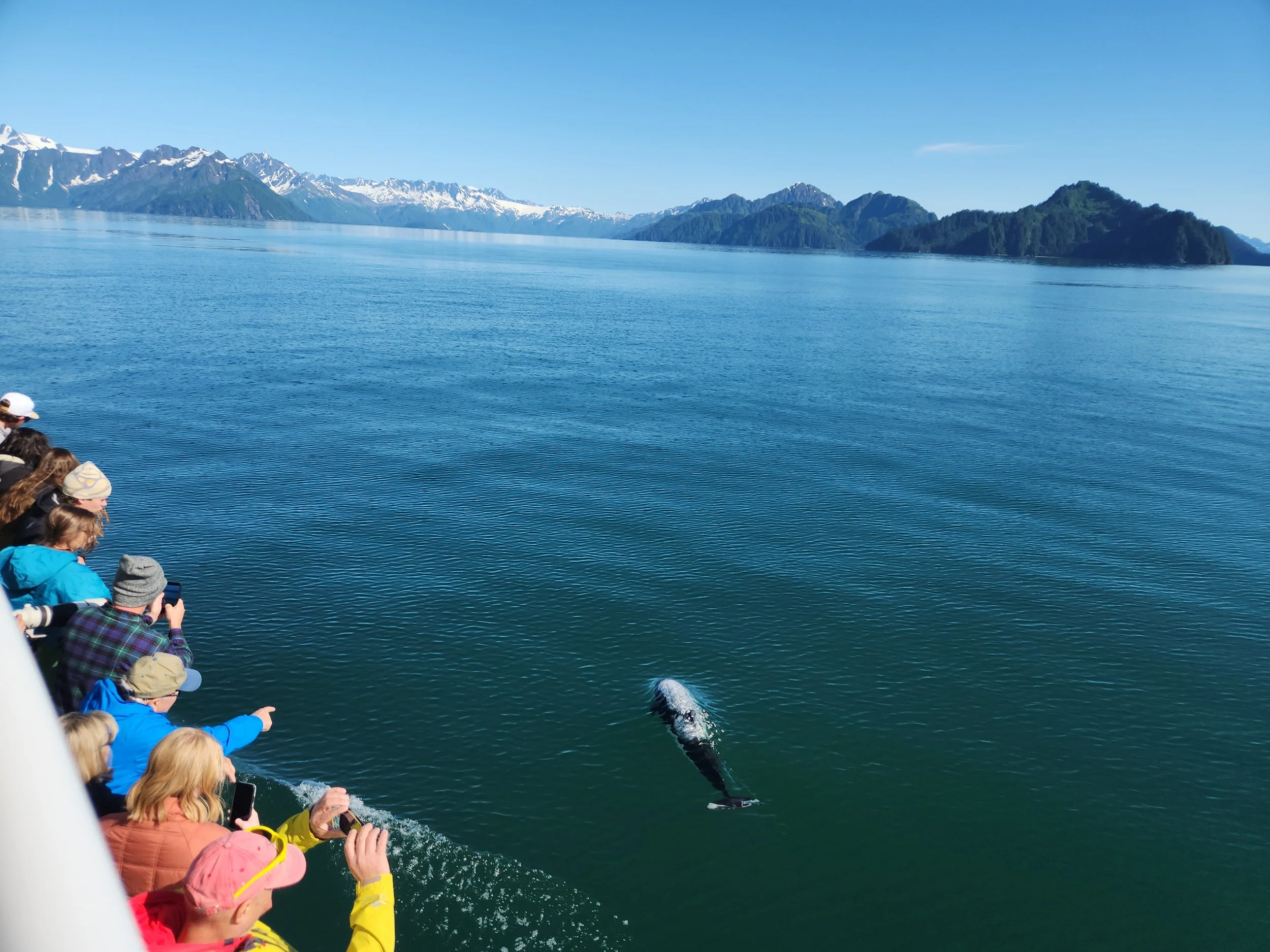
Trying to get photos of the wildlife while on the Kenai Fjords Boat Tour. This critter is a porpoise, not an orca. Photo by Carrie Dow.
Once the islands were behind us and nothing but water to the horizon, the captain slowed the boat down and announced we should start looking for whales. This was where they were normally founded, but it’s never guaranteed that you’ll see them. It didn’t take long before one of the crew members from below shouted “two o’clock.” Everyone, including a few people from inside, moved over to our side of the boat. We all searched the surface for a few minutes before three spouts of water blew into the air followed by the backs of three black swimmers. Orcas, the captain announced. He added that orcas are not really whales, but members of the dolphin family and are black on top and white underneath. He also speculated that this was a family pod of two adults with one juvenile, but because they were going away from us, he couldn’t be sure.
Then another shout came from the other side of the boat. Two more orcas were on that side running parallel to the boat. We followed them a bit. Another pod of three (perhaps it was the same family pod) appeared behind us. They were a bit livelier, coming out of the water more and slapping their tails on the water. We often saw the splashes more than the orcas. That made photos hard, so I took video instead because I could capture photos from the footage when I got home.
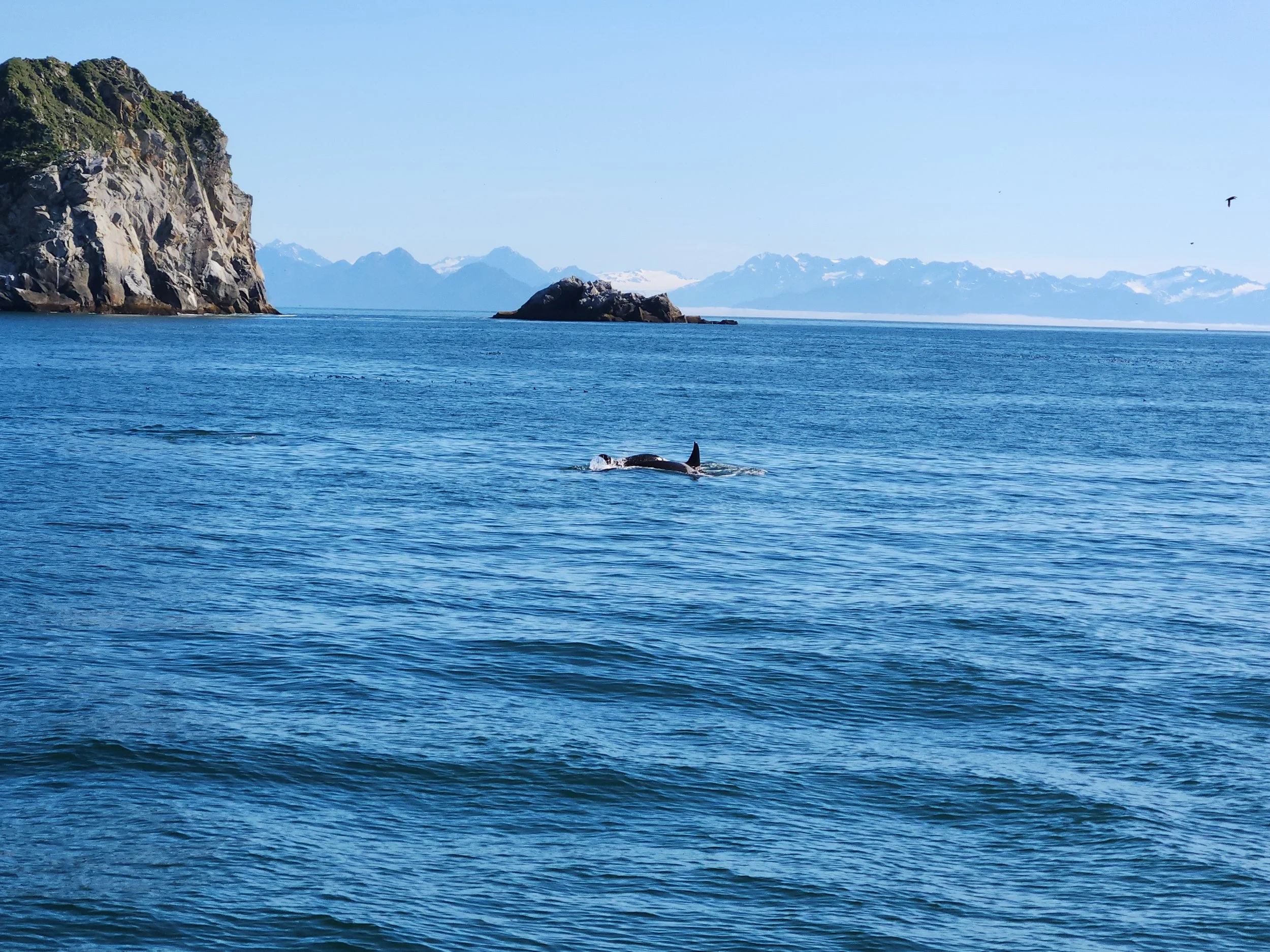
Orcas on the move in the North Pacific. Photo by Carrie Dow.
We were the only boat in the area slowly turning 380 degrees so every side of the boat could get a glimpse. Then the captain said we needed to move on so that other tour boats could have their time with the orcas, so we headed northwest just as another tour boat motored by. We headed into another long skinny fjord with mountains that were emerald on the bottom, black rock in the middle and spots of white snow on the tops. We were heading to Aialik Glacier, but first, lunch. The crew passed out chicken and veggie burritos with salsa.
The water was more turquoise as we went deeper into Aialik Bay. Then we noticed a small dark blob in the water. Suddenly the blob had arms and legs. It was an otter on its back floating in the tranquil bay. Tranquil that was until we passed by and the boat wake reached him causing him to bob up and down. He wasn’t expecting that and quickly dove down to get away.
As we approached the glacier, icebergs appeared, small at first, like ice cubes in a giant glass, but getting larger as the boat got closer. Upon the larger icebergs beige harbor seals rested, flopping their tails and looking at us, but not really interested in us.
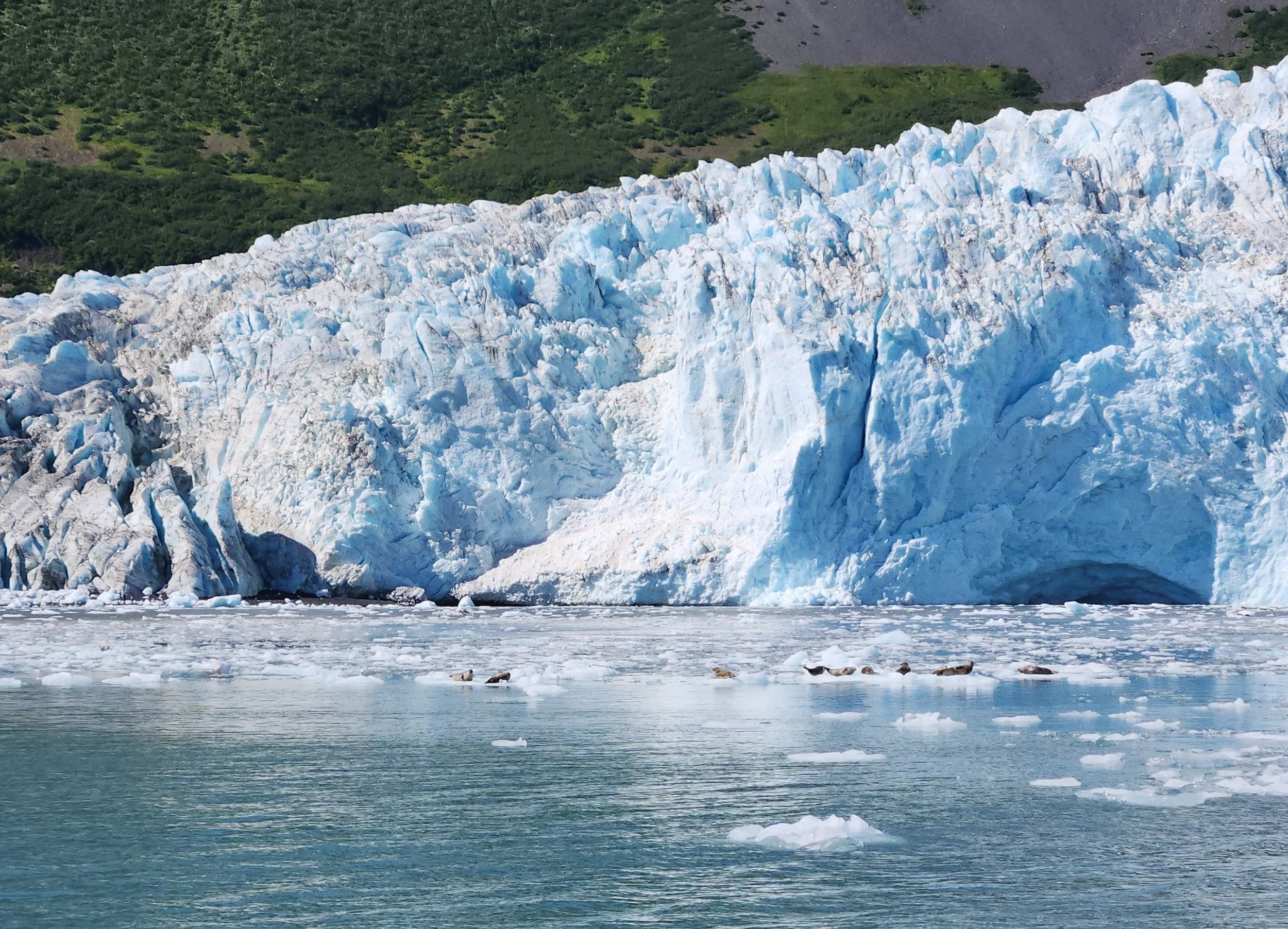
Harbor seals lounging on icebergs in front of Aialik Glacier. Photo by Carrie Dow.
The glacier was a stunning teal blue on the bottom becoming whiter near the top, but we could see streaks of dark silt along the top. We had learned earlier in the trip that silt was bits of earth and rock that get scraped up as the glacier moves. Small sections of the glacier calved off and fell into the water like tiny avalanches. And because sound travels slower, we would see a section fall and hear the muffled roar a few seconds later. A few seconds after that the waves from the ice chunks hitting the water would reach the boat causing us to bob slightly. On the rocks alongside the glacier, waterfalls of melting ice dropped into the water.
We stayed floating there for quite a while, the boat slowly turning so all sides could get a good view. The captain happened to have family members visiting him and they took a family photo in front of the glacier. Then he fired up the engines again and we slowly motored away from the glacier. The harbor seals continued lounging on the ice without waving goodbye.
***
Bonus animal activities:
Anchorage Zoo, while the zoo mostly serves and provides a home for Alaskan animals, they also have yaks, camels, and an Amur tiger. Also known as Siberian tigers, zoos in Alaska and western Cananda often have Amur tigers because of the similar climate and terrain and since these tigers are critically endangered, they need all the homes they can get.
Salmon (without the bears) was also on our animal agenda, and we found two places for viewing, one outside of Seward and one in Anchorage.
Seward – Bear Creek Weir is an artificial waterfall managed by the Cook Inlet Aquaculture Association. In operation since the 1960s, the group, working with ADWG, count and track the number of salmon and other fish to make sure populations are healthy. The weir is located on Bear Creek and it’s easily accessible, no hiking or stairs. However, the viewing area is tiny with very little parking, and it can get crowded with people on weekends.
Anchorage – Salmon Run Trail located in Anchorage’s Far North Bicentennial Park is a short sub-trail that follows Campbell Creek for less than a half mile. While we were there late in the season, we saw several large pink salmon slowly making their way upstream. The trail is part of the Campbell Airstrip Trail system and visitors can park at the Campbell Airstrip Trailhead for access to all the park’s trails. Biking is also popular here.
Alaska Wildlife Conservation Center in a 501(c)3 nonprofit that is open to the public with general admission tickets at $30 per adult, $24 per child. Days and hours of operation vary depending on the time of year so check the website. Walk on the Wild Side tours start at $140 per person and must be booked in advance online. These staff-guided tours a special animal encounter. Because this is an outdoor activity, be sure to check the weather and dress appropriately.
Kenai Fjord National Park Cruise Tours are a part of The Alaska Collection tourism-activity company. They offer a variety of boat tours from 3 hours to 9 hours. The “classic” tours are either half day (5.5-hour) and full day (7- and 8-hour) of Kenai Fjords National Park. We took the classic half day tour for $248/pp. Boats also operate seasonally so check the website for the full calendar. During the summer tourist season, boats regularly sell out so booking online in advance is highly recommended.
https://www.alaskacollection.com/day-tours/kenai-fjords-tours/
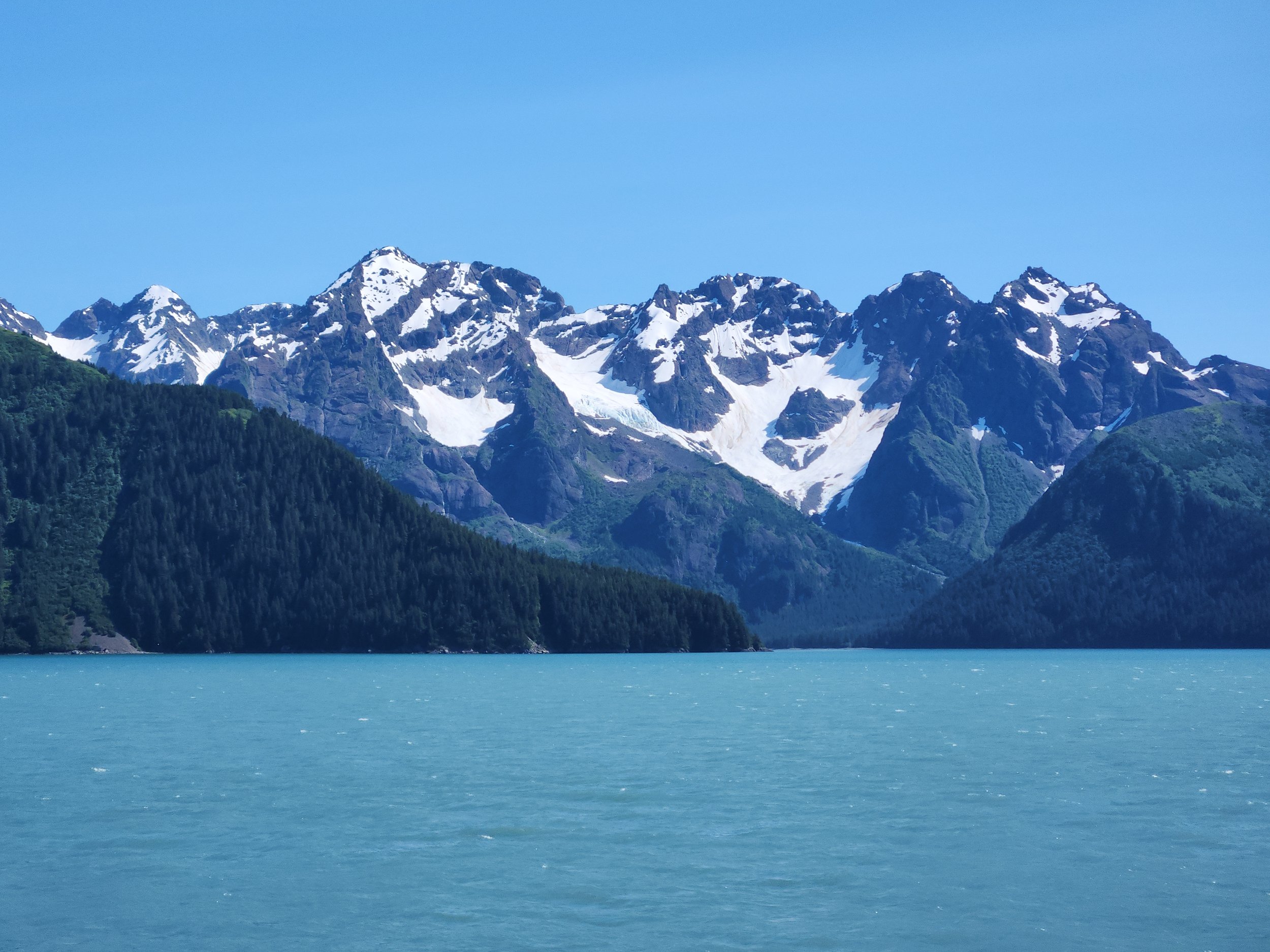
The views are stunning on the Kenai Fjords Boat Tour. Photo by Carrie Dow.